- Recommended name
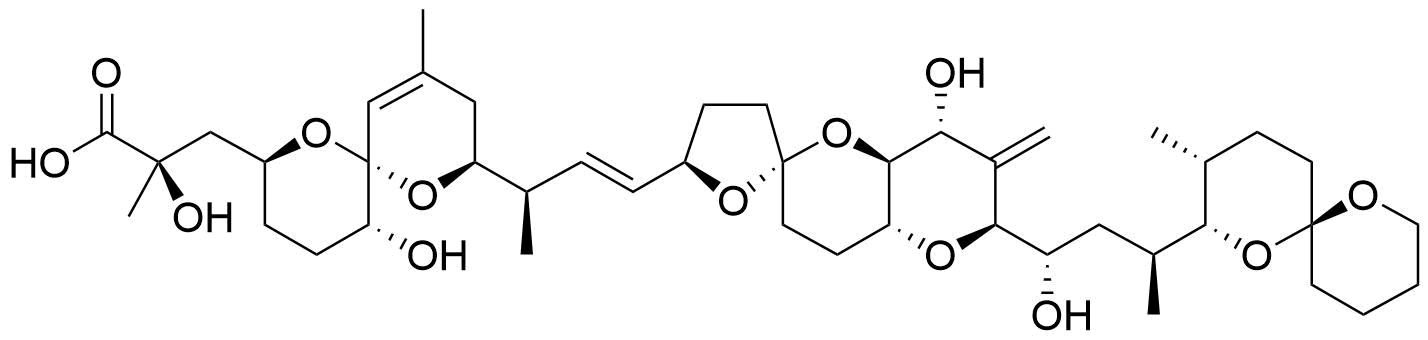
- Okadaic acid
- Synonyms
- 35-demethylDTX1, Acanthifolicin
- Recommended acronym
- OA
- Abbreviation
Progenitors
- Name
- Dinophysis fortii
- Name
- Dinophysis ovum
- Note
- The profilles of this species (of the "D. acuminata" complex) from two regions, Galiica (Spain) and Gulf of Mexico (USA) showed only OA US strains produced OA in culture (Ayache et al., 2023)
- Name
- Dinophysis sacculus
- Note
- Only traces of OA in cultured strains from Atlantic (Galicia, Spain) and Mediterranean (France) European coastal waters; both with predominance of PTX2 and only traces of DTX1
- Name
- Dinophysis miles
- Note
- High content of OA in HPLC analyses of picked cells in The Philippines. Cultures needed to confirm de novo production
- Name
- Dinophysis norvegica
- Note
- Only traces of OA in Northern European and Japanese strains with high content of PTXs No OA in NE USA cultured strains with a profile dominated by PTX-12 and only one congener of OA, dihydro-DTX1. Only PTXs in NW US strains
- Name
- Dinophysis acuta
- Note
- Most strains have a combination of 1.okadaates: OA and DTX1 or DTX2 and minor contribution of diol esters (OA-D7, OA-D8, OA-D9) 2. PTXs: PTX2 (dominant), PTX-11 with a few exceptions having only PTXs
- Name
- Dinophysis acuminata
- Note
- This species has strains with profiles containing: i) High content of OA (> 40 pg/cell) ONLY in the European Atlantic Arc; 1 strain in ii) Dominated by PTX2 and low to moderate (1-10 pg/cell) DTX-1 in NE USA, and eastern Japan. The same profile in net tows with D acuminata in southern Chile and picked cells iii) High in other congeners (DTX1 but no OA) and PTXs (NW USA and Canada) iv) No OA related toxins; only PTXs in Atacama (N Chile) and Danish fjords v) US strains produced varying ratios of OA, DTX1 (also esterified forms), together with PTX2 in culture (Ayache et al. 2023)
- Name
- Prorocentrum caipirignum
- Note
- Nascimento et al 2017
- Name
- Prorocentrum concavum
- Note
- Hu et al 1993
- Name
- Prorocentrum lima
- Note
- Murakami et al 1982
- Name
- Prorocentrum rhathymum
- Note
- Caillaud et al 2010
- Name
- Prorocentrum texanum
- Note
- Gulf of Mexico
- Name
- Dinophysis caudata
- Note
- High content of OA in HPLC analyses of picked cells in The Philippines. Cultures needed to confirm de novo production OA eventually found in LC-MS analyses of picked cells in the Galician Rías (NW Spain). Not found in cultures of only 2 strains tested Found in strain VGO1396 in culture, together with lower levels of DTX1 and DTX2, and trace levels of the 24-O-glucoside of OA (Wilkins et al. 2021)
Vector Species
- Name
- Cancer pagurus
- Name
- Mytilus edulis
References
- Sechet, V.; Sibat, M.; Billien, G.; Carpentier, L.; Rovillon, G. A.; Raimbault, V.; Malo, F.; Gaillard, S.; Perriere-Rumebe, M.; Hess, P., 2021
- Distinct toxin profiles in French strains of species of the "D. acuminata complex": D. acuminata (Atlantic coast) and D. sacculus (Mediterranean) coast)
- Marasigan, A. N.; Sato, S.; Fukuyo, Y.; Kodama, M., 2001
- Marasigan, A. N.; Sato, S.; Fukuyo, Y.; Kodama, M. Accumulation of a high level of diarrhetic shellfish toxins in the green mussel Perna viridis during a bloom of Dinophysis caudata and Dinophysis miles in Saipan Bay, Panay Island, the Philippines. Fish. Sci. 2001, 67, 994-996
- Ayache et al., 2023
- Ayache, N., Bill, B. D., Brosnahan, M. L., Campbell, L., Deeds, J. R., Fiorendino, J. M., Gobler, C. J., Handy, S. M., Harrington, N., Kulis, D. M., McCarron, P., Miles, C. O., Moore, S. K., Nagai, S., Trainer, V. L., Wolny, J. L., Young, C. S., & Smith, J. L. (2023). A survey of Dinophysis spp. and their potential to cause diarrhetic shellfish poisoning in coastal waters of the United States. Journal of Phycology, 59, 658–680.
- Wilkins et al., 2021
- Wilkins, A. L.; Rundberget, T.; Sandvik, M.; Rise, F.; Knudsen, B. K.; Kilcoyne, J.; Reguera, B.; Rial, P.; Wright, E. J.; Giddings, S. D.; Boundy, M. J.; Rafuse, C.; Miles, C. O. . Identification of 24-O-β-D-glucosides and 7-deoxy-analogues of okadaic acid and dinophysistoxin-1 and -2 in extracts from Dinophysis blooms, Dinophysis and Prorocentrum lima cultures, and shellfish in Europe, North America, and Australasia. Toxins 2021, 13 (8), 510.
- Structure
-
- Formula
- C44H68O13
- Exact mono-isotopic mass
- 804.46599
- Molfile
- See Chem Files
- Alternative molfiles
- n/a
- SMILES
- OC([C@](C)(O)C[C@@H]1CC[C@@H](O)[C@@]2(O[C@H]([C@H](C)/C=C/[C@@H]3O[C@]4(CC[C@@H](O[C@H]([C@@H](O)C[C@H](C)[C@H]5O[C@@]6(CCCCO6)CC[C@H]5C)C([C@H]7O)=C)[C@H]7O4)CC3)CC(C)=C2)O1)=O
- Alternative SMILES
- OC([C](C)(O)C[CH]1CC[CH](O)[C]2(O[CH]([CH](C)/C=C/[CH]3O[C]4(CC[CH](O[CH]([CH](O)C[CH](C)[CH]5O[C]6(CCCCO6)CC[CH]5C)C([CH]7O)=C)[CH]7O4)CC3)CC(C)=C2)O1)=O
- InChi key
- QNDVLZJODHBUFM-WFXQOWMNSA-N
- Alternative InChi keys
- n/a
- InChi
- InChI=1S/C44H68O13/c1-25-21-34(55-44(23-25)35(46)12-11-31(54-44)24-41(6,50)40(48)49)26(2)9-10-30-14-18-43(53-30)19-15-33-39(57-43)36(47)29(5)38(52-33)32(45)22-28(4)37-27(3)13-17-42(56-37)16-7-8-20-51-42/h9-10,23,26-28,30-39,45-47,50H,5,7-8,11-22,24H2
- Alternative InChis
- Spectra available
- True
- Chem files
- chemfiles/Okadaic_acid.cdxml chemfiles/Okadaic_acid.mol
References
- Tachibana, K., et al., 1981
- Bibliographic reference of original description: Tachibana, K., et al., Okadaic acid, a cytotoxic polyether from two marine sponges of the genus Halichondria. Journal of the American Chemical Society, 1981. 103(9): p. 2469-2471.
- Certified
- True
- Certified links
-
- EURLMB
Certified and non-certified reference materials are listed
- EURLMB
- Non certified reference material
- True
Chemical analysis
- Research
- True
- Standardized
- True
- Validated
- True
- Official
- EURLMB (EU-harmonised protocol)
Structure recognition assays
- Research
- True
- Standardized
- False
- Validated
- False
- Official
- n/a
Functional assays
- Research
- True
- Standardized
- False
- Validated
- False
- Official
- n/a
Animal assays
- Research
- True
- Standardized
- True
- Validated
- False
- Official
- n/a
References
- EURLMB, 2015
- EU REFERENCE LABORATORY FOR MONITORING OF MARINE BIOTOXINS EU-Harmonised Standard Operating Procedure for determination of Lipophilic marine biotoxins in molluscs by LC-MS/MS
- EURLMB, 2010
- METHOD FOR DETECTION OF OKADAIC ACIDTOXINS GROUP IN EDIBLE MOLLUSCS Rev 4 October 2010 Standard Operating Procedures method for the quantitative determination of OA and other carboxylic toxins of the OA group including DTX1, DTX2, DTX3 by a colorimetric phosphatase inhibition assay. The OkaTest method fulfils the requirements of Chapter III A (4) a, b, and c of Annex III to Regulation (EC) 2074/2005 and can be used as supplementary method to EU-RL LC/MS/MS method only for the detection of Okadaic Acid group toxins OA, DTX1,DTX2, DTX3 including their esters. The use of OkaTest method is not an alternative to the EU-RL LC/MS/MS method.
- Regulatory status
- True
References
- Lawrence, J., et al., 2011
- Lawrence, J.; Loreal, H.; Toyofuku, H.; Hess, P.; Iddya, K.; Ababouch, L. Assessment and management of biotoxin risks in bivalve molluscs. FAO Fisheries and Aquaculture Technical Paper No. 2011, 551, 337 pages. Website: http://www.fao.org/3/i2356e/i2356e.pdf, last accessed 10/02/2023.
- Human toxic syndrome(s)
- Diarrhetic Shellfish Poisoning
- Organ system toxicity
- Gastro-intestinal toxicity
- Risk assessment
- True
- Molecular targets known
- True
- Molecular targets
- Protein phosphatase 2A, Protein phosphatase 1
- Toxic to aquatic animals
- True
- TEF available
- True
Risk assessment References
- EFSA, 2008
- EFSA. Marine biotoxins in shellfish - Okadaic Acid and analogues, Scientific Opinion of the Panel on Contaminants in the Food chain, adopted on 27 November 2007. EFSA Journal 2008, 589, 1-62. Last accessed 10/02/2023
- Lawrence, J., et al., 2011
- Lawrence, J.; Loreal, H.; Toyofuku, H.; Hess, P.; Iddya, K.; Ababouch, L. Assessment and management of biotoxin risks in bivalve molluscs. Website: http://www.fao.org/3/i2356e/i2356e.pdf, last accessed 27/08/2021. FAO Fisheries and Aquaculture Technical Paper No. 2011, 551, 337 pages.
TEF References
- FAO, 2016
- FAO/WHO. 2016. Technical paper on Toxicity Equivalency Factors for Marine Biotoxins Associated with Bivalve Molluscs. Rome. 108 pp.
- Botana, L., et al., 2017
- Botana, L. M.; Hess, P.; Munday, R.; Nathalie, A.; DeGrasse, S. L.; Feeley, M.; Suzuki, T.; van den Berg, M.; Fattori, V.; Gamarro, E. G.; et al. Derivation of toxicity equivalency factors for marine biotoxins associated with Bivalve Molluscs. Trends in Food Science & Technology 2017, 59, 15-24.
- Notes
References
- Tachibana, K., et al., 1981
- Bibliographic reference of original description: Tachibana, K., et al., Okadaic acid, a cytotoxic polyether from two marine sponges of the genus Halichondria. Journal of the American Chemical Society, 1981. 103(9): p. 2469-2471.
- Larsen, K., et al., 2007
- Larsen, K.; Petersen, D.; Wilkins, A. L.; Samdal, I. A.; Sandvik, M.; Rundberget, T.; Goldstone, D.; Arcus, V.; Hovgaard, P.; Rise, F.; et al. Clarification of the C-35 stereochemistries of dinophysistoxin-1 and dinophysistoxin-2 and its consequences for binding to protein phosphatase. Chem. Res. Toxicol. 2007, 20 (6), 868-875, Article. DOI: 10.1021/tx700010m.